
Virginia 24 Hour Booking Records
Virginia 24 hour booking records are public documents created when someone is arrested and processed at a county jail, regional detention facility, or city lockup. These records come from sheriff's offices, police departments, and detention centers across 95 counties and 39 independent cities. Each booking creates a file that includes the person's name, arrest date, charges, and bond conditions. You can search these records through county sheriff websites, the VADOC inmate locator, and Virginia's online court systems. This guide covers the main sources for finding 24 hour booking records in Virginia, sorted by location and agency type.
Virginia 24 Hour Booking Overview
What Virginia 24 Hour Booking Records Contain
When law enforcement arrests someone in Virginia, the booking process begins right away. Officers transport the person to a county jail or regional facility where staff document a range of personal details. A 24 hour booking record captures a snapshot of the arrest at a specific moment in time. These records are not evidence of guilt. An arrest is not a conviction, and every person booked is presumed innocent unless proven otherwise in court.
Virginia arrest records are comprehensive documents covering physical characteristics, personal information, arrest and booking specifics, and details about the alleged crime. A typical booking record includes the person's full name, date of birth, physical description, arresting agency, date and time of booking, charges filed, and bond or bail conditions set by the magistrate. Mugshots taken during the initial intake process are part of the public record under Virginia Code § 2.2-3706. That statute requires law enforcement agencies to release adult arrestee photographs taken during intake unless doing so would jeopardize an active investigation. Any chronological listing of adult arrests is also a public document under that same law.
Virginia has 95 counties and 39 independent cities, each maintaining its own separate arrest records system. Some county sheriff websites offer free access to recent arrest information through online inmate rosters. Detailed searches through official channels may involve fees for document reproduction. The state does not maintain one single centralized 24 hour booking database, which means you often need to contact the specific agency that made the arrest to get the most current records.
Records that are not public include Social Security numbers, medical and mental health information, details about ongoing investigations, information identifying confidential informants, and any records involving juveniles. Law enforcement may also withhold records where release could cause a suspect to flee, endanger ongoing operations, or lead to the destruction of evidence.
VADOC Inmate Locator for Virginia Bookings
For people in state custody, the Virginia Department of Corrections Inmate Locator is the main search tool. The VADOC maintains records for approximately 29,790 inmates in state prisons and another 669 in jail facilities across Virginia. You search by entering at least the first letter of the person's first name along with their full last name, or by using the inmate's seven-digit ID number. Search results are updated daily and show the facility location and release date for those in VADOC custody. Inmates not under VADOC custody will not appear in these results, so if someone was recently booked at a county jail and not yet transferred to state custody, you need to contact the local facility directly.
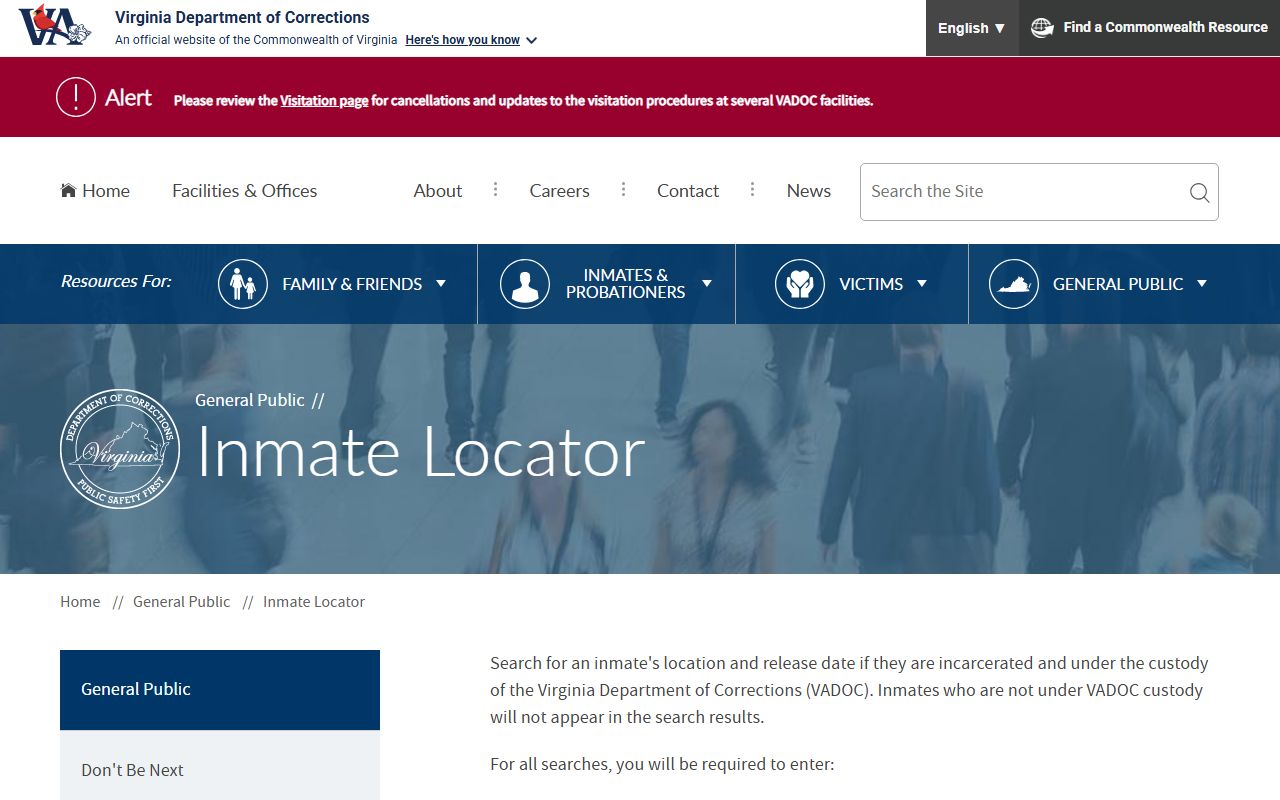
The VADOC Inmate Locator at vadoc.virginia.gov allows daily-updated searches for individuals held in state correctional facilities, showing current housing location and projected release date.
The Virginia Department of Corrections promotes public safety in the Commonwealth by providing care and re-entry services to sentenced individuals. The department operates with an annual budget of $1.2 billion and a staff of 12,600 employees. It offers education, programming, and treatment to people in its care. VADOC also posts updates to operating procedures monthly, covering things like inmate correspondence, telephone services, and visitation policies. For county-level and city-level 24 hour booking records, you need to contact the relevant sheriff's office or detention center directly, since those records may not reflect immediately in the VADOC system.
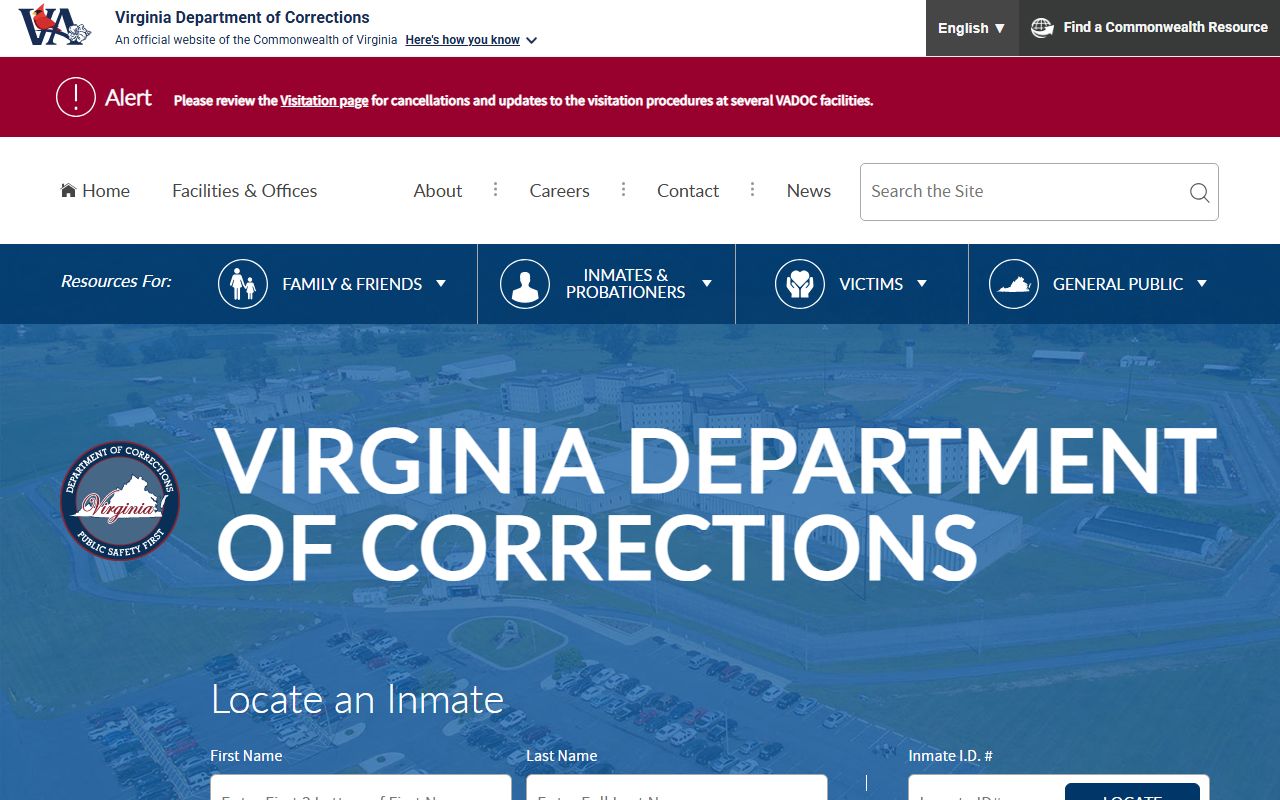
The VADOC website at vadoc.virginia.gov is the main portal for accessing the inmate locator, facility directories, and policy documents governing offender records and re-entry services.
Virginia 24 Hour Booking Court Case Search
Virginia courts maintain online case information systems that can help you track criminal cases tied to 24 hour booking records. The Virginia Court Case Information system provides access to civil and criminal cases in select circuit courts across the state. You can search by name, case number, or hearing date. Results show party names, case status, and upcoming court dates. The Case Alert Subscription System, known as CASS, provides free text and email notifications whenever a case is updated, which can be useful for tracking what happened after an initial arrest and booking.
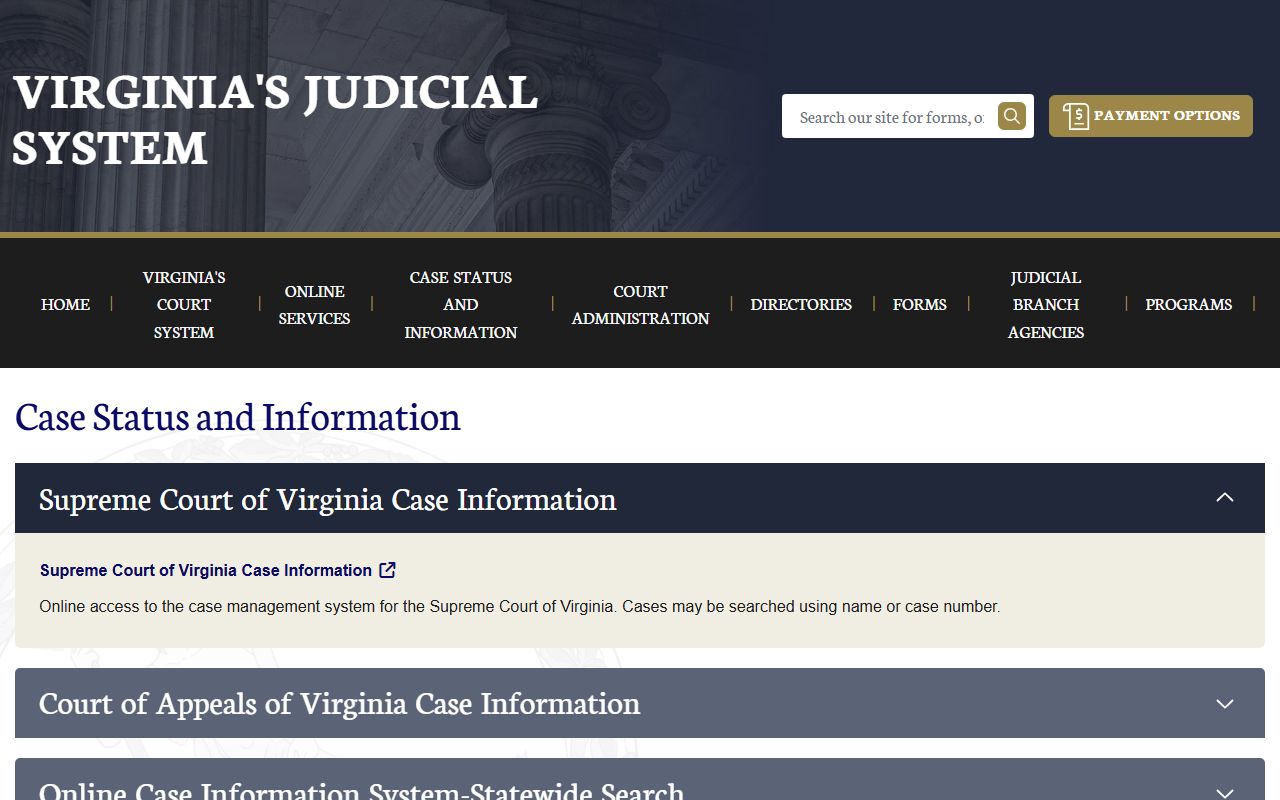
The Virginia Court Case Information portal at vacourts.gov shows case status, charge details, and hearing dates for criminal matters that follow an initial arrest and 24 hour booking entry.
The Circuit Court Online Case Information system is real-time and current, used by 117 of the 120 circuit courts in Virginia. You can search by name, case number, or hearing date. When searching by case number, use upper case "CR" for criminal cases or "CL" for civil cases. The system provides tabs for case name lists, pleadings and orders, and service information. This tool covers trial-level cases and is especially useful after a person has been booked, arraigned, and formally charged.
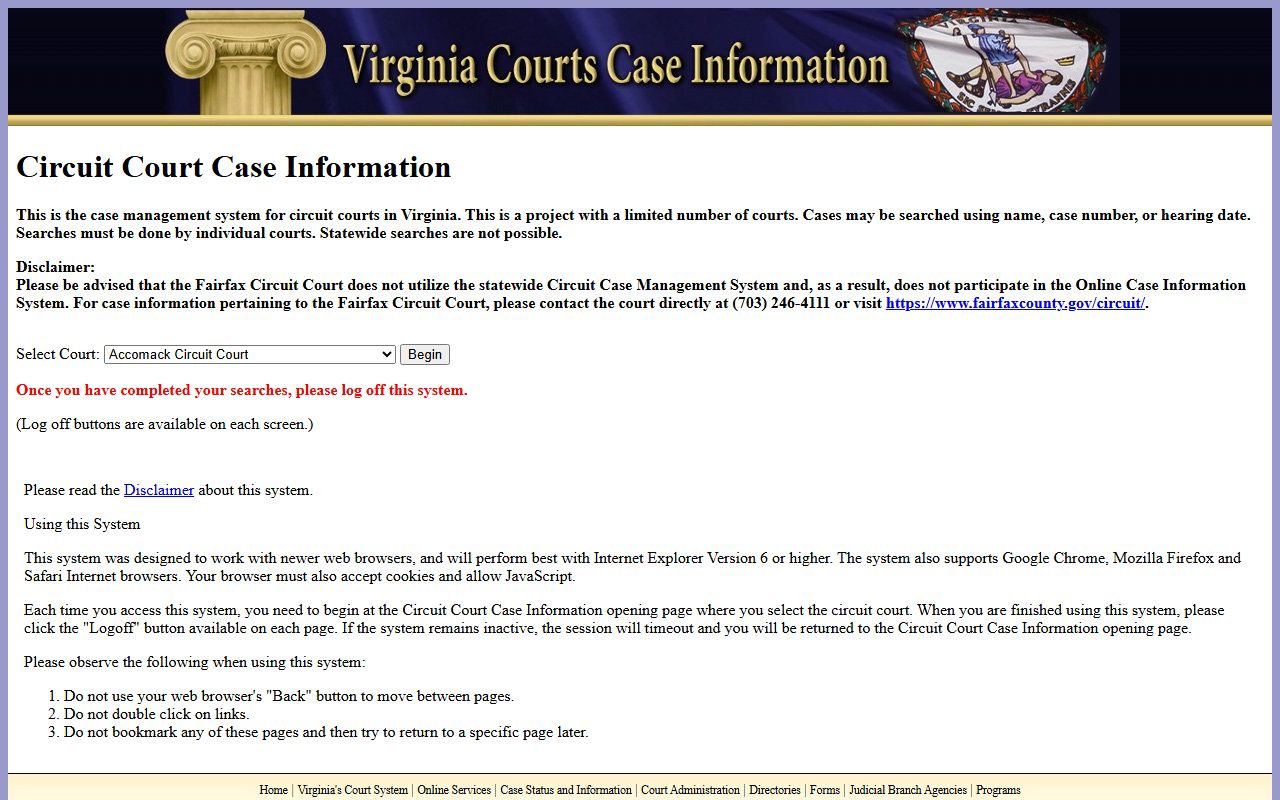
Virginia's Circuit Court Online tool at eapps.courts.state.va.us lets you search by name or case number to find criminal case details, including felony cases that started with a 24 hour booking at a county or city jail.
The Virginia Courts Online Services portal is the central access point for multiple court functions. From there you can reach the Appellate Case Management System, the Circuit Court Online Case Information System, the General District Court Online Case Information System for traffic and misdemeanor matters, and Juvenile and Domestic Relations court information. The portal also allows users to pay fines and costs and submit e-filed documents. Most courts allow mail-in requests for full case files with proper identification and applicable fees.
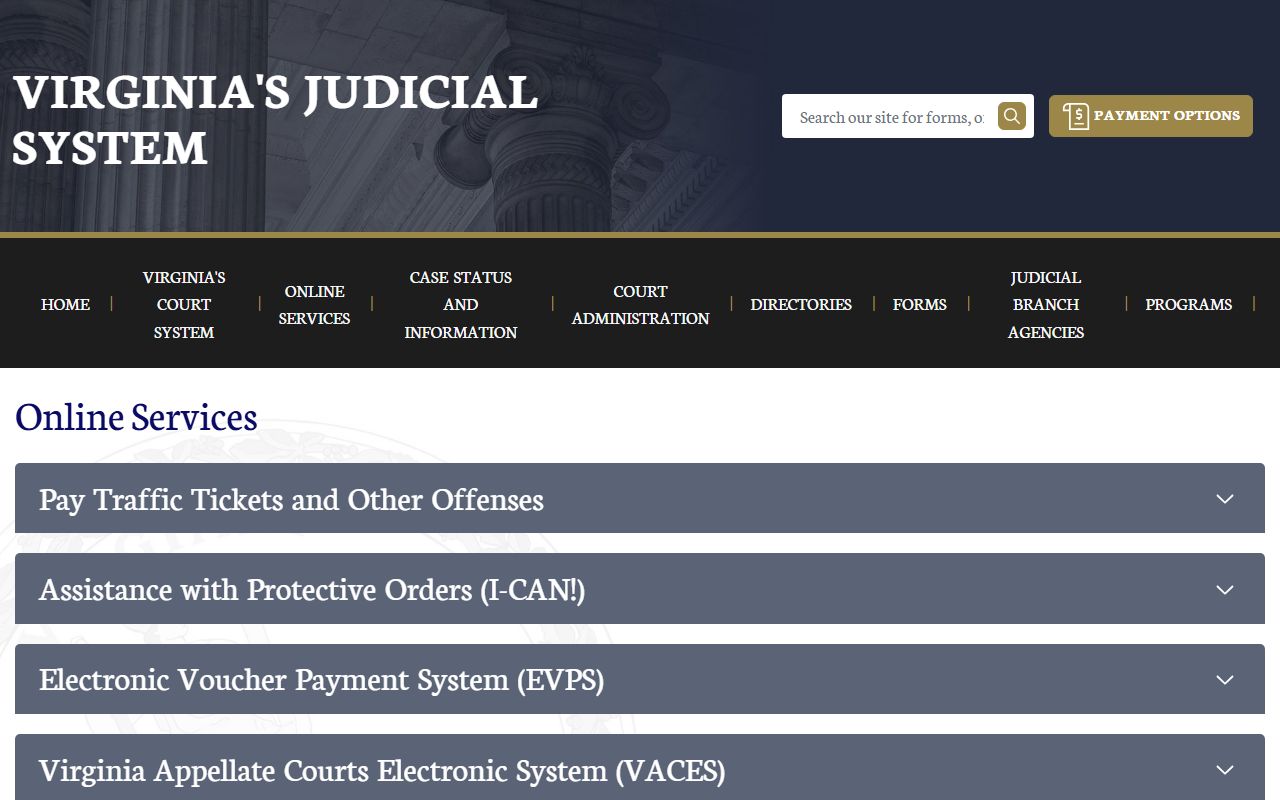
The Virginia Courts Online portal at vacourts.gov serves as the main gateway for searching criminal case records, court filings, and case status information across all court levels in the state.
Virginia FOIA and 24 Hour Booking Records
The Virginia Freedom of Information Act, codified at § 2.2-3706 of the Code of Virginia, governs how law enforcement discloses arrest and booking information. Under this statute, agencies must release specific types of information when requested. Required disclosures include the general description of criminal activity, the date of the alleged crime, the general location of the incident, the identity of the investigating officer, and a general description of any injuries or property damage. The identity of any adult who is arrested and charged is also public information that cannot be withheld.
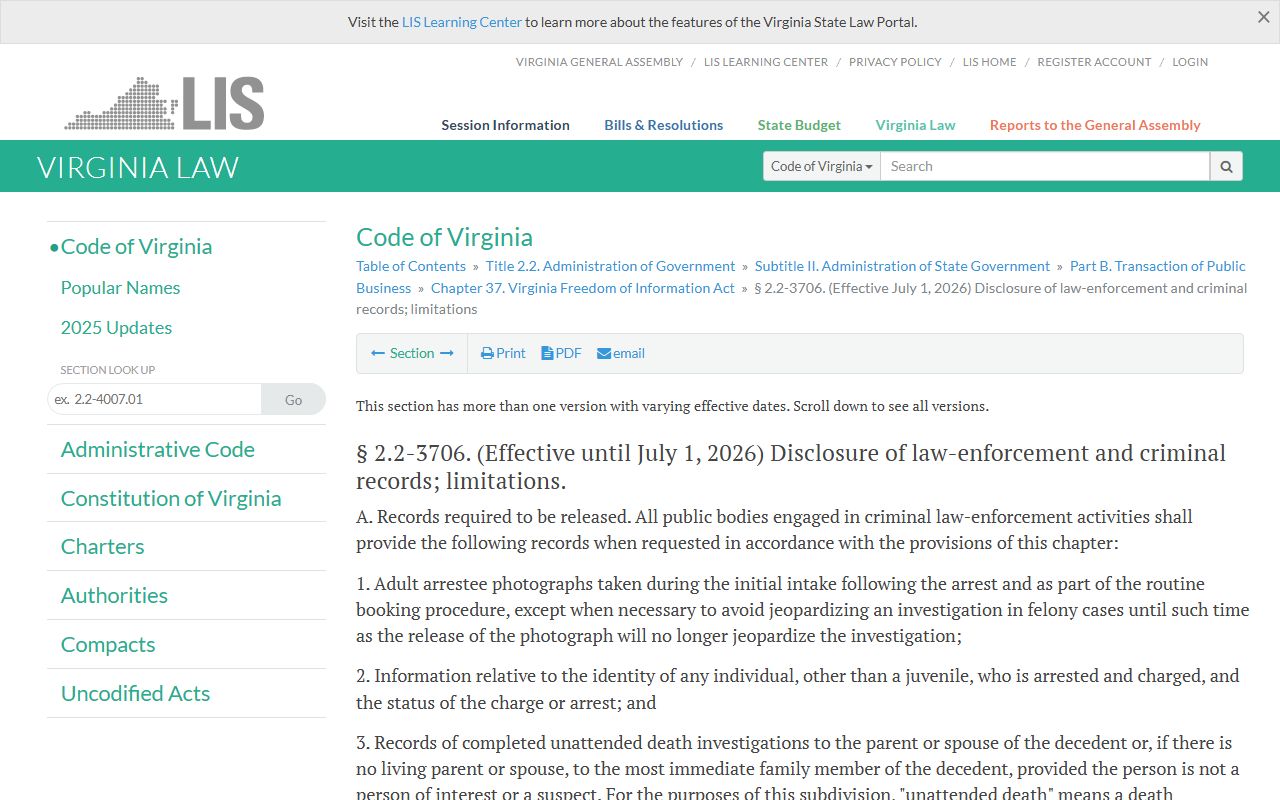
Virginia Code § 2.2-3706 at law.lis.virginia.gov spells out exactly what booking and criminal incident information law enforcement agencies must make available to the public, including adult arrest photos taken during intake.
Public bodies must respond to FOIA requests within five working days of receiving the request. If that is not practically possible, the agency must notify you and gets an additional seven working days to respond. Fees may not exceed actual costs for searching, copying, and supplying records. No agency can tack on extra charges to cover general overhead costs. Before beginning a search, the agency must tell you about potential costs and ask if you want a cost estimate first.
Note: Virginia FOIA requests submitted by phone are not always accepted; written or electronic submissions give you a clearer record of your request and the agency's obligations under the law.
Virginia 24 Hour Booking Arrest Procedures
Virginia has a unique magistrate system that operates around the clock, seven days a week. Magistrates are judicial officers appointed by circuit court judges for four-year terms. Their main function is to provide independent, unbiased review of complaints brought by police officers, sheriff's deputies, and private citizens. Virginia is unique among states in having this kind of dedicated magistrate structure. Magistrates can issue arrest warrants, search warrants, admit people to bail or commit them to jail, issue subpoenas, administer oaths, and issue emergency protective orders. Before issuing a warrant, a magistrate must find that probable cause exists based on the facts presented.
Under Virginia Code § 19.2-72, a magistrate may issue an arrest warrant when a sworn complaint establishes probable cause that a crime was committed and that the named person committed it. The warrant must name or describe the accused, describe the offense with reasonable certainty, and command the arrest. Virginia Code § 19.2-82 requires that a person arrested without a warrant be brought before a magistrate without delay. This can happen in person or through two-way electronic video and audio communication, which is how many Virginia jails handle after-hours hearings. Any person arrested must be read the charges on each warrant during the booking process.
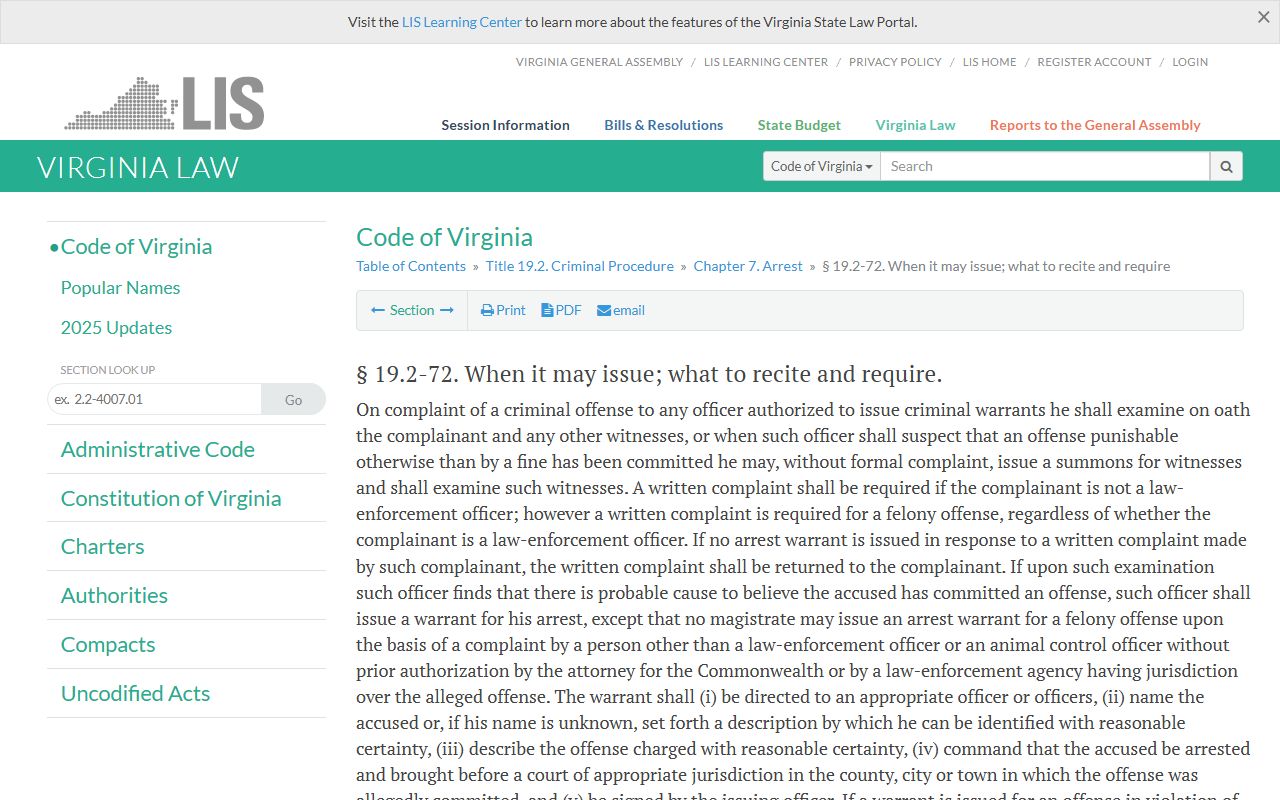
Virginia Code § 19.2-72 at law.lis.virginia.gov sets out the legal requirements for arrest warrants, establishing the probable cause standard that begins the booking and detention process at county and city jails.
The process from warrant service to magistrate hearing typically takes two to six hours in Virginia. After booking, the magistrate sets bail conditions by weighing the nature of the offense, the person's family ties, employment status, financial resources, past criminal record, and the likelihood of appearing in court. Under § 19.2-74, officers may release a person on a summons for Class 3 or Class 4 misdemeanors instead of booking them into jail, unless specific exceptions apply such as DUI charges, public drunkenness, or a reasonable belief the person will not appear as required.
Finding Virginia Arrest and Booking Records
Virginia arrest records are public documents that cover physical characteristics, personal information, arrest and booking specifics, alleged crime details, and interrogation information. Access to these records is generally available under the Virginia Freedom of Information Act. Some county sheriff websites offer free access to recent arrest information through public inmate rosters that update daily or weekly. Detailed records requests through official channels may involve small fees for document reproduction.
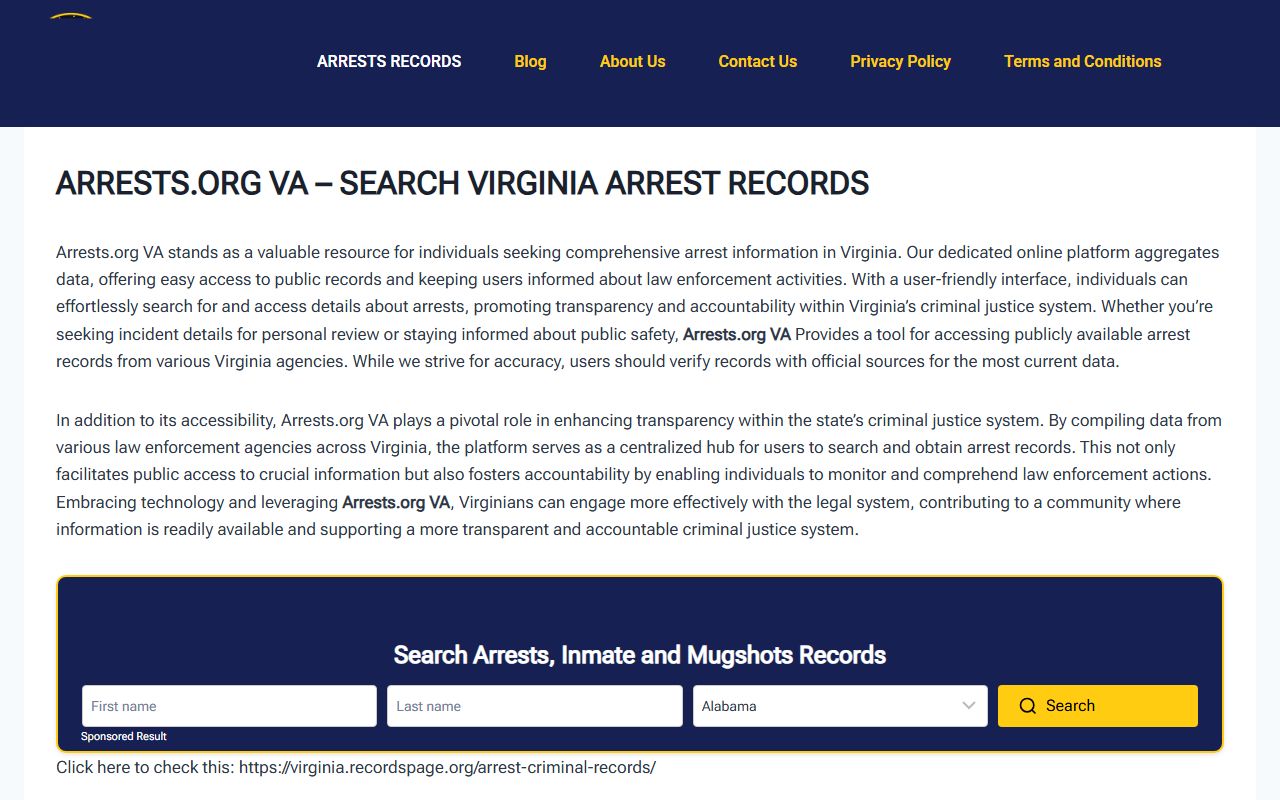
The Virginia Arrest Records Guide at va-arrests.org covers how to search for booking records, what information is typically included, and which agencies maintain records across the state's 95 counties and 39 independent cities.
Under Virginia Criminal Procedure § 19.2-392.2, individuals who meet specific criteria can petition for expungement of certain arrest records. The expungement process involves obtaining fingerprints, filing a petition in the appropriate court, and attending a hearing. Virginia also passed a broader record sealing law that takes effect July 1, 2026, which will allow automatic sealing for about 90% of all misdemeanor convictions and nearly two-thirds of Class 5 and 6 felony convictions. The Justice Forward Virginia Foundation provides detailed guidance on eligibility under both the current and upcoming rules.
The Justice Forward Virginia Foundation at justiceforwardvafoundation.org explains Virginia's new record sealing law taking effect in 2026, covering automatic sealing eligibility for prior convictions and arrest records.
Virginia State Police Criminal Records
The Central Criminal Records Exchange (CCRE) of the Virginia Department of State Police maintains criminal history records for the state. To get a full criminal background check, you submit a notarized SP-176 form through the Virginia State Police's Civil and Applicant's Record Exchange, known as the CARE system. Online forms may be notarized using NotaryCam for added convenience. The cost for a criminal history name file search is $15 per search. A combined criminal history and sex offender registry search costs $20.
The Virginia State Police also maintains the Sex Offender and Crimes Against Minors Registry. The registry contains names, personal descriptions, conviction details, and photographs of individuals convicted of specific sex offenses. It can be searched by name, address, city, county, or zip code. No charge applies for searches of violent offender registrations through the public website. Registry information is updated regularly but may not reflect the most current status at all times.
Note: Criminal history checks from the Virginia State Police reflect statewide conviction records, not just local booking records. A 24 hour booking that did not result in a conviction may not appear in VSP's CCRE database.
Browse Virginia 24 Hour Booking by Location
Virginia 24 hour booking records are maintained at the county and independent city level. Each sheriff's office and police department keeps its own records system, and regional jails serve multiple jurisdictions in many parts of the state. Use the links below to find booking information for a specific county or city.
Virginia Counties
Virginia has 95 counties, each with a sheriff's office responsible for booking records and jail operations. Regional jails serve many smaller counties. Select a county below to find resources specific to that area, including sheriff contact details, local search tools, and regional facility information.
Virginia Independent Cities
Virginia's 39 independent cities operate their own law enforcement and detention systems separate from the surrounding county. Each city maintains its own booking records and jail facilities, or contracts with a regional jail for housing.